How does AI work?
🎬 Step 1: Meet the Data Scientist
Imagine Maya is a data scientist. Her boss walks in and says:
“We need a system that can look at a photo of any fruit and tell us what it is — automatically.”
Maya nods. She knows exactly what to do. She’s going to build a Machine Learning (ML) model — a piece of code that learns patterns from examples, just like you learned what a banana looks like as a child.
🍌 Step 2: Collecting the Fruits (Data)
Maya gathers 100 pictures of fruits:
- Apples 🍎
- Bananas 🍌
- Peaches 🍑
This collection is called a dataset.
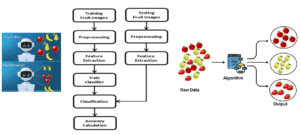
🧠 Step 3: Teaching the AI (Training Phase)
Maya doesn’t show all 100 images at once.
Instead:
- 80 images → used to teach the AI → called the training dataset
- The AI studies patterns:
- Apples are round and red
- Bananas are long and yellow
- Peaches are soft and orange
👉 During this step, a classification algorithm helps the AI group similar fruits together.
🔍 Step 4: Testing the AI (Evaluation Phase)
Now Maya wants to check if the AI really learned.
- The remaining 20 images are used as a test dataset
- These are images the AI has never seen before
If the AI correctly identifies them, it means:
✅ The learning worked!
🧺 Step 5: How the AI Thinks
Inside the AI model, something interesting happens:
- It groups fruits by similarity
- Apples together 🍎
- Bananas together 🍌
- Peaches together 🍑
This is how classification works:
👉 “Which group does this new image belong to?”
✨ Step 6: The Moment of Truth
Now a user (maybe you!) uploads a new fruit image.
The AI asks:
“Which group does this look like?”
If it matches the apple group →
🎉 The AI says: “This is an apple!”
🎯 Final Takeaway (Simple Way to Remember)
- Data = examples (fruit images)
- Training = learning patterns
- Testing = checking understanding
- Classification = grouping similar things
- Prediction = guessing new images correctly